
Sometimes pest infestations are obvious. You spot a dense web packed with gypsy moth caterpillars hanging in the branches, and there’s no mistaking what you’re dealing with. Other times, the signs are subtle enough to be confused with disease, drought stress, or nutrient deficiency. Knowing what to look for makes it easier to catch a problem early, before it reaches the point where your tree is in serious decline.
Here are the most common signs that pests have moved into your trees, and what those signs usually mean. If you’re seeing several of these at once, it’s time to call a certified arborist. Michigan State University Extension has documented how quickly untreated infestations can escalate into full tree loss.
Chewed Leaves
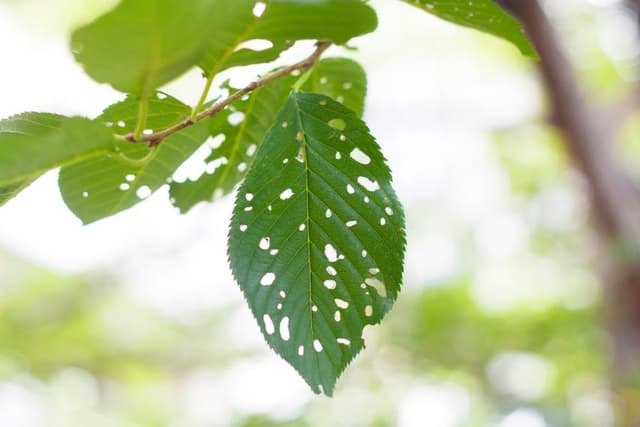
Ragged leaf edges and irregular holes through leaf tissue are classic signs of insect feeding. Caterpillars, grasshoppers, leaf miners, and beetles are the usual culprits. The pattern of damage often points to the specific pest: leaf miners leave winding pale trails through the leaf itself, while caterpillars tend to consume entire sections from the margins inward. Not every chewed leaf signals an emergency, but widespread feeding across the canopy is worth a closer look.
Wilted or Discolored Leaves
Yellowing, browning, or blackening leaves that also appear wilted are frequently the result of sap-feeding insects rather than disease or drought. Spider mites and aphids don’t consume leaf tissue the way chewing insects do. They pierce the surface and extract plant fluids, which disrupts the leaf’s ability to photosynthesize and move water. The result looks similar to drought stress or fungal issues, which is why pest diagnosis matters before you start treating for the wrong problem.
If you’re uncertain whether you’re dealing with pests or disease, the Colorado State University Extension insect diagnostics program can help narrow down the cause based on symptoms.
Damaged Bark
Bark damage caused by borers and bark beetles is some of the most serious pest damage a tree can sustain because it targets the vascular tissue just beneath the bark that moves water and nutrients throughout the tree. The emerald ash borer is a well-known example: this metallic green beetle lays its eggs under the bark of ash trees, and the larvae chew winding tunnels through the cambium as they feed. Once mature, the adult beetle exits through a D-shaped hole in the bark. Heavy infestations disrupt water transport enough to kill limbs and eventually the entire tree.
Other signs of bark pest activity include entry holes, sawdust-like frass at the base of the tree, and oozing sap or pitch tubes at wound sites. Any of these warrant immediate professional assessment.
Branch Dieback
Branch dieback follows a predictable pattern: death starts at the tips and progresses back toward the trunk. Affected branches lose their leaves, the bark dries and cracks, and the wood becomes brittle. In advanced cases the tree has a skeletal appearance with leafless branches across significant portions of the canopy. Bark beetles and borers are common causes, as their feeding activity in the cambium starves branches of nutrients. Without intervention, dieback continues until the tree is dead.
Galls and Abnormal Growths
Galls are irregular, often round or lumpy growths that form when tiny wasps, aphids, or mites inject chemicals into the tree tissue, triggering abnormal cell growth. They can look like small wrinkled apples, spiny nodules, or waxy blobs depending on the pest species. Some trees also produce tumor-like growths in response to bacterial or pest activity. Galls alone rarely threaten tree health, but they’re a reliable indicator that pests are present and active, and heavy galling on young or already-stressed trees can compound other problems.
Sticky Residue on Leaves and Bark
A sticky coating on leaves, branches, or even surfaces below the tree (patio furniture, cars, pavement) is usually honeydew, a byproduct excreted by sap-feeding insects like aphids, scale, and whiteflies. It has the texture of diluted syrup and is a reliable sign that sap-sucking pests are active overhead. Left unchecked, honeydew creates secondary problems: it supports sooty mold growth, which blocks sunlight from leaf surfaces, and it attracts ants that actively protect aphid colonies from natural predators.
According to the USDA Forest Service, sap-feeding insect populations can expand rapidly when natural predator populations are disrupted, making early identification and treatment critical.
Don’t Wait on a Pest Problem
Pest infestations don’t improve on their own. A small aphid colony doubles in days. A bark beetle gallery expands with every larva that hatches. The window between ‘manageable problem’ and ‘tree is unsaveable’ can close faster than most property owners expect.
If you’re seeing any of these signs on your Boulder property, contact the team at Roots Up Tree Company. We provide pest assessment, targeted treatment, and tree removal when that’s the right call. Call us or schedule online, and we’ll get eyes on your trees before the problem gets ahead of you.