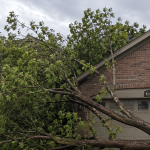


A tree can look completely fine from the sidewalk and still be a serious liability. That’s one of the most frustrating things about structural tree failure – it often happens without obvious warning. But there are signs, if you know what you’re looking for.
Whether you’re managing a residential property or a commercial site in Boulder, knowing these five warning signs could save you from a dangerous situation – or a very expensive insurance claim.
1. Cracks or Splits in the Trunk
Not all cracks are equal, but none of them are something to ignore. A longitudinal crack running vertically along the trunk often indicates the tree is under significant mechanical stress – this can happen from wind loading, frost cracking, or internal decay that has caused uneven tissue expansion.
Co-dominant stems (two main trunks growing from the same base with a tight V-shaped union) are especially risky. Without enough space for proper bark inclusion, the wood bond between the stems can fail without warning, particularly in high winds or after an ice storm. If you see cracks at the union point of a V-crotch, treat it as urgent.
2. Leaning That Has Changed or Accelerated
Trees grow toward light, so a slight lean is normal. What’s not normal is a lean that has visibly increased over a short period, especially one accompanied by soil heaving or cracking at the base.
When a tree starts to lean more noticeably, it’s often because the root system has been compromised – by construction damage, root rot, soil compaction, or erosion. Once the root plate can no longer anchor the tree under its own weight, the lean accelerates. This is a situation where waiting to call a tree service in Boulder is not advisable.
3. Decay, Cavities, or Fungal Growth
Fungal conks – those shelf-like mushroom structures you sometimes see growing out of a trunk – are an indicator of internal wood decay. By the time fruiting bodies appear on the outside of the tree, decay is typically well-established on the inside. The tree may still be standing, but it’s structurally weaker than it appears.
Cavities are another concern. A hollow section in the lower trunk or main scaffold limbs removes the structural material that supports the tree’s weight. A trained arborist can assess how much wall thickness remains and whether the tree can be safely managed or needs to come down.
4. Dead or Hanging Branches in the Upper Canopy
Dead branches – sometimes called widow-makers – are one of the most common sources of tree-related property damage and injury. They don’t hold on indefinitely. Wind, rain, and their own weight eventually bring them down, and there’s rarely a warning before it happens.
Pay attention to branches with no leaves during the growing season, branches with dried and cracked bark, or large limbs that seem to be hanging partially detached. Routine tree trimming in Boulder addresses these before they become a hazard. This is exactly the kind of work that prevents emergency calls.
5. Root Zone Problems
The roots are doing the structural work of holding a tree upright, and they’re the part you can least easily see. Look for:
- Soil that has lifted or cracked in a circle around the base of the tree
- Exposed roots that show rot, soft spots, or unusual discoloration
- Signs of girdling roots – roots that have wrapped around the base and are constricting trunk growth
- Construction or trenching activity near the root zone that may have severed key structural roots
Root zone damage is serious precisely because it’s invisible until the tree is already compromised. If you know your trees have been through construction disturbance or prolonged drought, a professional assessment is worth doing proactively.
What to Do If You Spot These Signs
Don’t wait to see if things improve. Structural tree problems don’t resolve themselves – they progress. The right move is to get a qualified arborist on-site to evaluate the tree and give you a clear picture of the risk level and your options.
Our team provides structural assessments throughout Boulder. We’ll walk your property, identify the specific risk factors, and give you honest recommendations – whether that’s targeted trimming, cabling and bracing, or removal when that’s the only safe option. Give us a call or schedule an inspection online.